9. Nesting#
Nest packs the selected parts onto the stock so the least material is wasted. It is a Path Tool, not an operation — it moves your geometry and generates no toolpath.
The goal is not only to fit everything on. It is to leave what's left over as one usable piece, rather than as scraps between parts.
Using it#
Select the parts, open Nest from Path Tools, set the options, and press Nest on Stock.
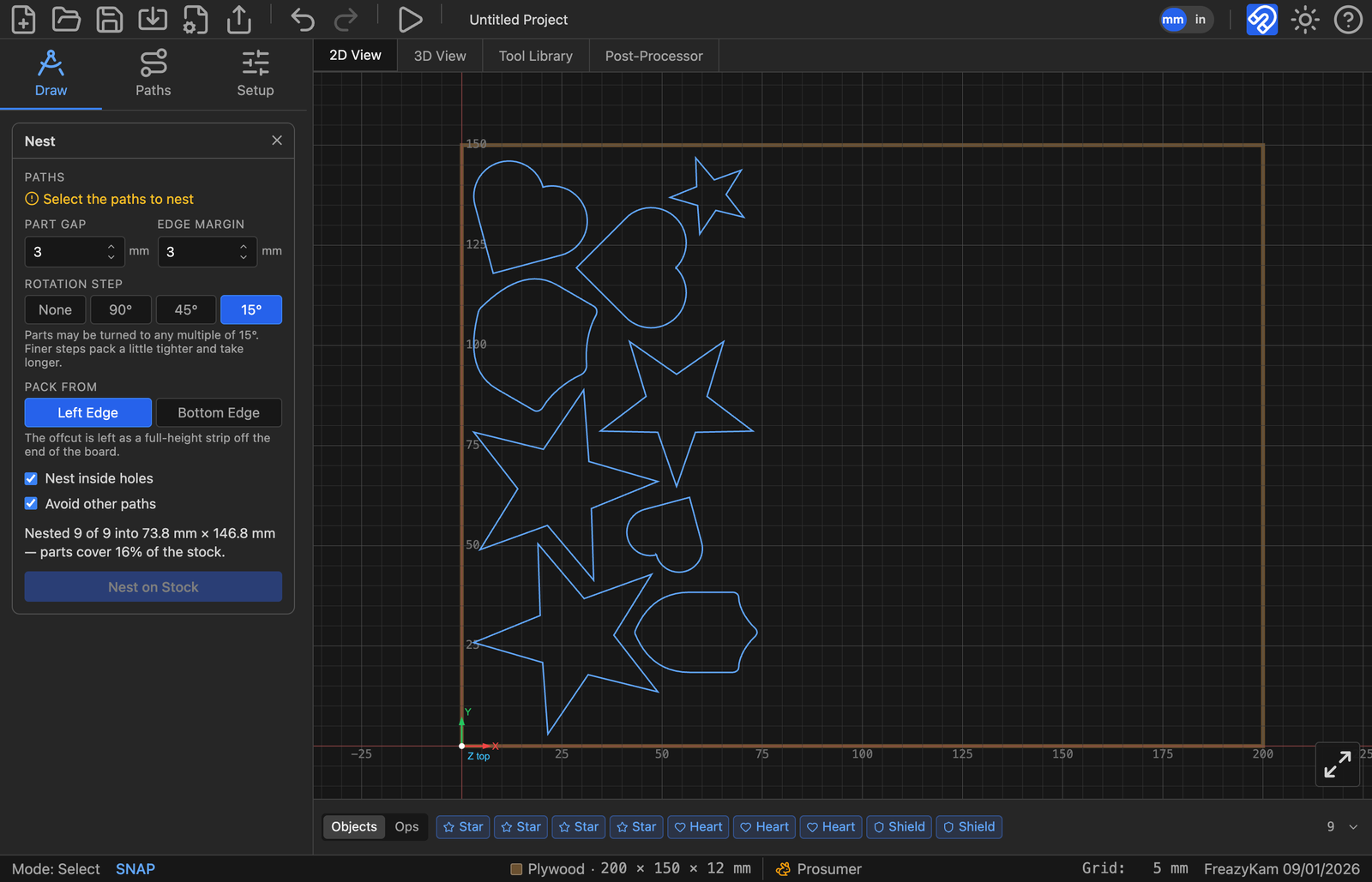
Nine parts packed from the left edge. The report reads "Nested 9 of 9 into 73.8 mm × 146.8 mm — parts cover 16% of the stock", and what's left is a full-height strip you can put back on the rack.
Anything that won't fit is parked clear of the stock rather than silently dropped, so you can see what didn't make it and decide what to do.
The settings#
| Setting | What it does |
|---|---|
| Part Gap | Space between parts. At minimum, leave room for the cutter plus tabs |
| Edge Margin | Space kept clear at the edge of the stock — for clamps, and for the fact that the edge of a board is rarely straight |
| Rotation Step | How freely parts may be turned |
| Pack From | Which edge parts pile against, and therefore what shape the offcut is |
| Fill stock with copies | Repeat a single part until no more fit |
| Nest inside holes | Let small parts sit in the holes of larger ones |
| Avoid other paths | Treat unselected paths as ground already taken |
Rotation Step is a step, not a limit#
This is the one that looks broken if you misread it. 45° does not mean "up to 45°" — it means parts may be turned to any multiple of 45°, so a half turn is allowed. And 15° allows everything 45° does, plus more.
| Setting | Use when |
|---|---|
| None | The stock has a grain to follow, or the parts are veneer-faced. Parts stay as drawn |
| 90° | Sheet goods where you still want a tidy, square layout |
| 45° | A reasonable compromise |
| 15° | Tightest packing. Slowest to compute |
Finer steps pack a little tighter and take longer. On plywood or MDF there is no reason not to use 15°; on anything where the grain shows, use None and accept the waste.
Pack From decides the shape of the offcut#
Both options waste the same area. They differ in what shape it's in, and that is what decides whether it's stock or scrap:
- Left Edge — the offcut is a full-height strip off the end of the board.
- Bottom Edge — the offcut is a full-width band along the top.
Pick whichever leaves a piece you'd actually use. A long narrow strip is useful for rails and edging; a wide shallow band suits panels.
Nest inside holes#
Lets a small part drop into the middle of a ring or a large opening. It saves material, with one consequence stated plainly: the offcut comes out in pieces. You are trading the one-usable-piece goal for raw yield. Worth it on expensive stock, often not worth it on plywood.
Avoid other paths#
Treats paths you didn't select as ground already taken. This is how you add parts to a board that already has work laid out on it — select only the new parts, tick this, and they will pack into the space that's left rather than on top of what's there.
Fill stock with copies#
Available when exactly one part is selected. Repeats it until no more fit, at the same gaps. Each copy is an object in its own right — cut it, move it or delete it like any other, and the report tells you how many were added.
Reading the report#
After a nest, the form reports what happened:
Nested 9 of 9 into 73.8 mm × 146.8 mm — parts cover 16% of the stock.
- "9 of 9" — everything fitted. A smaller first number means some parts were parked off the stock.
- The dimensions are the bounding box the parts actually occupy, which tells you how much board you'd need if you cut this layout from a smaller piece.
- The percentage is coverage, not efficiency. Awkward shapes cover a low percentage and may still be packed as tightly as they can be.
Before you cut#
Nesting moves your parts. Two things follow:
- Operations that referenced those paths need regenerating — they'll be marked amber in the Ops strip.
- Check your holding tabs. Tabs travel with the path, but a tab that was in a sensible place before may now be facing a neighbour with 3 mm between them.
Next#
- 10. Simulating and exporting — the review before you cut
- 11. When something goes wrong