Why inlays fit#
The problem with straight walls#
A straight plug in a straight hole must be the exact size. A bit too big won't go in. A bit too small leaves a gap.
V-walls solve it#
Cut both halves with the same V-bit. The plug is a wedge, the socket a matching wedge. Push the plug in and it slides down until the walls meet. Wherever it stops, it's tight.
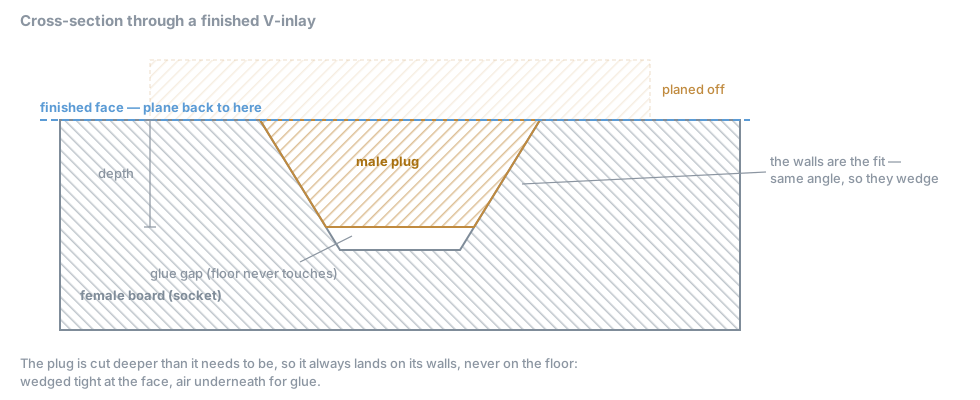
From that picture:
- The walls are the joint. Same bit angle on both halves.
- The bottom must not touch. That's the Glue gap. Glue needs somewhere to go.
- You make the face by sanding. Glue it, let it cure, then plane down to the socket board's surface. The seam closes as you get there.
Why Mirror#
The plug board is flipped over to go in. Text or any one-sided design would read backwards. Mirror cuts the plug reversed so it reads right after flipping.
Why not a taper#
A taper's tip is rounded. On the plug, that rounding ends up at the top edge, where you look. On the socket, it's at the bottom. They don't match, so a hairline gap shows: about 0.2 mm for a 0.25 mm tip. The angle doesn't matter. The plug still seats, but you'll see the line.
A V-bit has a true point, so plug and socket match exactly.
Why Invert#
A design inside a background can be read two ways: the design is the plug, or the background is. Invert chooses. The form says which in words, so you can check.
How-to: Make an inlay